EventRelay
EventRelay turns event publication and event processing into durable, tracked work. Bedrock stores Platform Event or generic payloads as Event__c rows, then ordered lanes drain them through publishers or handlers.
Overview
EventRelay is Bedrock’s durable event framework. It is for event work that
should survive the caller’s transaction, keep visible status, preserve lane
order, and make success or failure inspectable.
The public model is intentionally small:
- Start work: call
EventRelay.publish(...)with Platform Event SObjects, or generic payloads when the event should leave the org. - Ingest work: call
EventRelay.ingest(...)with Platform Event SObjects or generic payloads when the event should be processed by Apex. - Coordinate work: call
EventRelay.stage(...)andEventRelay.flush()when several services need to add publish-side Platform Events in one transaction. - Customize processing: extend
EventRelay.Handlerand overrideexecute(List<SObject>)orexecute(List<Generic>). - Customize publication: extend
EventRelay.Publisherand overrideexecute(List<SObject>)orexecute(List<Generic>). - Keep lanes ordered: route work into a stable lane key so each lane drains in FIFO order while other lanes can run separately.
Use EventRelay when event publication or consumption is important enough to
track. Common cases include Platform Events that represent integration handoffs,
durable webhook publication, and inbound event triggers that need retryable,
visible Apex processing instead of silent trigger failure.
Reach for direct EventBus.publish(...) instead when the publication is small,
non-critical, and does not need durable status, ordered lanes, or item-level
operational review. Reach for a normal Platform Event trigger when native
trigger behavior is enough and you do not need durable handler status.
Quickstart
Using EventRelay for normal Platform Event publication is one call. Build
Platform Event SObjects, then publish them through the relay instead of calling
EventBus.publish(...) directly.
List<SObject> events = new List<SObject>{
    new Account_Changed__e(
        Account_Id__c = account.Id,
        Change_Type__c = 'HealthChanged'
    )
};

List<Id> workItemIds = EventRelay.publish(events);
The caller creates one Event__c work item for each event payload. EventRelay
stores the serialized payload, places it on a publish lane, and returns the new
work item Ids.
The built-in publisher later rehydrates those payloads back into Platform Event
SObjects and calls EventBus.publish(...) in a background transaction.
For inbound event processing, add a one-line trigger and a handler.
trigger AccountChangedTrigger on Account_Changed__e(after insert) {
    EventRelay.ingest(Trigger.new, AccountChangedHandler.class);
}
public with sharing class AccountChangedHandler extends EventRelay.Handler {
public override void execute(List<SObject> records) {
for (SObject record : records) {
Id accountId = (Id) record.get('Account_Id__c');
// Process the event payload.
}
}
}The trigger stores process work and returns. The handler runs later, and each
selected work item becomes Done or Error.
Examples
Publish an account integration event
This service records an integration event without publishing it inline. The service owns the business decision; EventRelay owns durable publication.
public with sharing class AccountIntegrationEventService {
    public List<Id> publishHealthChanged(List<Account> accounts) {
        List<SObject> events = new List<SObject>();

        for (Account account : accounts) {
            events.add(
                new Account_Health_Changed__e(
                    Account_Id__c = account.Id,
                    Health_Score__c = account.Health_Score__c
                )
            );
        }

        return EventRelay.publish(events);
    }
}
Each Account_Health_Changed__e becomes an Event__c row with Job_Type__c = 'Publish', Status__c = 'Pending', and a route-specific thread key. The
publication happens later when Thread starts the EventRelay publish pool.
Stage several Platform Events before flushing
Use stage when separate services need to add Platform Events during the same
transaction. Use flush once at the orchestration boundary.
public with sharing class OrderEventService {
    public void stageSubmitted(Order__c order) {
        EventRelay.stage(
            new List<SObject>{ new Order_Submitted__e(Order_Id__c = order.Id) }
        );
    }

    public void stageFulfillmentRequested(Order__c order) {
        EventRelay.stage(
            new List<SObject>{
                new Fulfillment_Requested__e(Order_Id__c = order.Id)
            }
        );
    }

    public List<Id> flushEvents() {
        return EventRelay.flush();
    }
}
Staging keeps the caller from scattering Event__c inserts across the
transaction. Nothing is persisted until flush() runs.
Ingest Platform Events from a trigger
Use ingest when a Platform Event trigger should persist the payload and process
it later through a handler.
trigger OrderSubmittedTrigger on Order_Submitted__e(after insert) {
    EventRelay.ingest(Trigger.new, OrderSubmittedHandler.class);
}
public with sharing class OrderSubmittedHandler extends EventRelay.Handler {
public override void execute(List<SObject> records) {
Set<Id> orderIds = new Set<Id>();
for (SObject record : records) {
orderIds.add((Id) record.get('Order_Id__c'));
}
List<Order__c> orders = (List<Order__c>) Query.records(
[
SELECT Id, Status__c
FROM Order__c
WHERE Id IN :orderIds
]
);
for (Order__c order : orders) {
order.Status__c = 'Submitted';
}
DML.updateRecords(orders);
}
}The handler receives SObjects for Platform Event payloads. For generic payloads,
override execute(List<Generic>) instead.
Publish through a custom SObject publisher
Pass a publisher type when Platform Event-shaped payloads should be delivered by
your own publisher instead of the built-in EventBus.publish(...) publisher.
public with sharing class WebhookEventPublisher extends EventRelay.Publisher {
    public override void execute(List<SObject> records) {
        for (SObject record : records) {
            try {
                sendWebhook(record);
            } catch (Exception error) {
                fail(record, error.getMessage());
            }
        }
    }

    void sendWebhook(SObject record) {
        // Build and send the callout in the shape your integration expects.
    }
}EventRelay.publish(
new List<SObject>{
new Order_Submitted__e(Order_Id__c = order.Id)
},
WebhookEventPublisher.class
);By default, every payload is treated as successful if execute completes. Call
fail(record, message) for individual records that should end in Error.
Publish generic payloads
Generic payloads are for publishers that do not start from a Platform Event SObject. They require routing because EventRelay needs to know which publisher class and lane should receive the payload.
public with sharing class OrderWebhookPublisher extends EventRelay.Publisher {
    public override void execute(List<Generic> records) {
        for (Generic record : records) {
            String orderNumber = (String) record.get(
                'orderNumber',
                String.class
            );
            if (String.isBlank(orderNumber)) {
                fail(record, 'Order number is required.');
                continue;
            }

            sendWebhook(record);
        }
    }

    void sendWebhook(Generic record) {
        // Build and send the callout from the Generic payload.
    }
}EventRelay.publish(new List<Generic>{
new Generic(new Map<String, Object>{
'orderNumber' => '1001',
'status' => 'Ready'
})
});Generic publishing requires an active Event_Config__mdt record whose
Source_Type__c, Direction__c, Routing_Key__c, and Routing_Value__c
match the payload.
Idempotent Intake
Configure Idempotency_Key_Path__c on a route when repeated delivery should
create an audit row without running duplicate work. For Platform Event routes,
the value is a field API name. For Generic routes, the value is a Generic
path. Explicit class calls, such as publish(events, MyPublisher.class), also
read the path when matching route metadata exists.
List<Id> workIds = EventRelay.publish(new List<SObject>{
    new Order_Submitted__e(
        Order_Number__c = '1001',
        Status__c = 'Ready'
    )
});
If EventRelay has already accepted or completed work for the same job type,
route, and key, the new Event__c row is inserted as Stale with an
explanatory message and is not enqueued.
Configuration
Use Event_Config__mdt when EventRelay should resolve the publisher or handler
without an explicit Apex type. One config record defines one route.
For Platform Event ingestion, configure a route like this:
| Field | Value |
|---|---|
DeveloperName | OrderSubmittedIngest |
Active__c | true |
Direction__c | Ingest |
Source_Type__c | PlatformEvent |
Routing_Key__c | SObjectType |
Routing_Value__c | Order_Submitted__e |
Apex__c | OrderSubmittedHandler |
Batch_Size__c | 50 |
Then the trigger can rely on metadata routing:
trigger OrderSubmittedTrigger on Order_Submitted__e(after insert) {
    EventRelay.ingest(Trigger.new);
}
For generic payloads, Routing_Key__c is the key EventRelay reads from the
Generic payload, and Routing_Value__c is the value that selects the route.
EventRelay.ingest(new List<Generic>{
    new Generic(new Map<String, Object>{
        'EventType' => 'OrderSubmitted',
        'orderNumber' => '1001'
    })
});
That payload resolves to a config like this:
| Field | Value |
|---|---|
DeveloperName | OrderSubmittedGenericIngest |
Direction__c | Ingest |
Source_Type__c | Generic |
Routing_Key__c | EventType |
Routing_Value__c | OrderSubmitted |
Apex__c | OrderSubmittedHandler |
DeveloperName is the route and thread key for metadata-backed routes. Keep it
stable once work exists. Batch_Size__c overrides EventRelay’s default batch
size for that route. Max_Retries__c caps framework-managed automatic retry for
failed publish and process work on that route. Idempotency_Key_Path__c enables
duplicate detection for the route.
Ingesting Work
ingest is the direct entry point for events that should be processed by Apex.
List<Id> platformEventWork = EventRelay.ingest(platformEvents, OrderSubmittedHandler.class);
List<Id> genericWork = EventRelay.ingest(genericPayloads, OrderSubmittedHandler.class);
The Platform Event overload accepts only SObjects whose API names end in __e.
Each payload becomes an Event__c row with Job_Type__c = 'Process' on the
EventRelayProcess pool.
You can pass a handler explicitly:
EventRelay.ingest(Trigger.new, AccountChangedHandler.class);The overloads without a handler type resolve active Event_Config__mdt records.
Platform Event routes match Source_Type__c = 'PlatformEvent',
Routing_Key__c = 'SObjectType', and Routing_Value__c equal to the Platform
Event API name. Generic routes match the configured key and value from the
payload.
Publishing Work
publish is the direct entry point for work that should be created immediately.
It returns the Ids of the inserted Event__c rows.
List<Id> platformEventWork = EventRelay.publish(platformEvents);
List<Id> customPublisherWork = EventRelay.publish(platformEvents, WebhookEventPublisher.class);
List<Id> genericWork = EventRelay.publish(genericPayloads);
The Platform Event overload accepts only SObjects whose API names end in __e.
Passing ordinary records, such as Account, raises an error.
Staging and flushing
stage(List<SObject>) buffers Platform Event SObjects in the current
transaction. flush() persists the buffered events and clears the buffer.
EventRelay.stage(new List<SObject>{ new Order_Submitted__e(Order_Id__c = order.Id) });
EventRelay.stage(new List<SObject>{ new Order_Audited__e(Order_Id__c = order.Id) });

List<Id> workItemIds = EventRelay.flush();
Calling flush() again after the buffer is empty returns an empty list.
Routes & Lanes
Every Event__c work item records a route and a thread key.
The default publish-side Platform Event route uses the event API name for both
the route and payload type. For an Account_Changed__e payload, the lane key is:
Publish:Account_Changed__e:Account_Changed__eWhen an explicit publisher type is passed, the route includes the publisher class name so the custom publisher gets its own lane:
Account_Changed__e:AccountWebhookPublisher
Publish:Account_Changed__e:Account_Changed__e:AccountWebhookPublisher
Matching metadata can fan one payload out to several routes. In that case,
EventRelay creates one Event__c row per resolved route. Each row can have its
own publisher class and thread key.
Metadata-backed routes use the Event_Config__mdt.DeveloperName as both the
stored route and thread key. That keeps the lane stable without adding a
separate thread-key field to the config.
When an explicit handler type is passed to ingest, the process lane uses
Process, the payload type, and the handler route:
Account_Changed__e:AccountChangedHandler
Process:Account_Changed__e:Account_Changed__e:AccountChangedHandler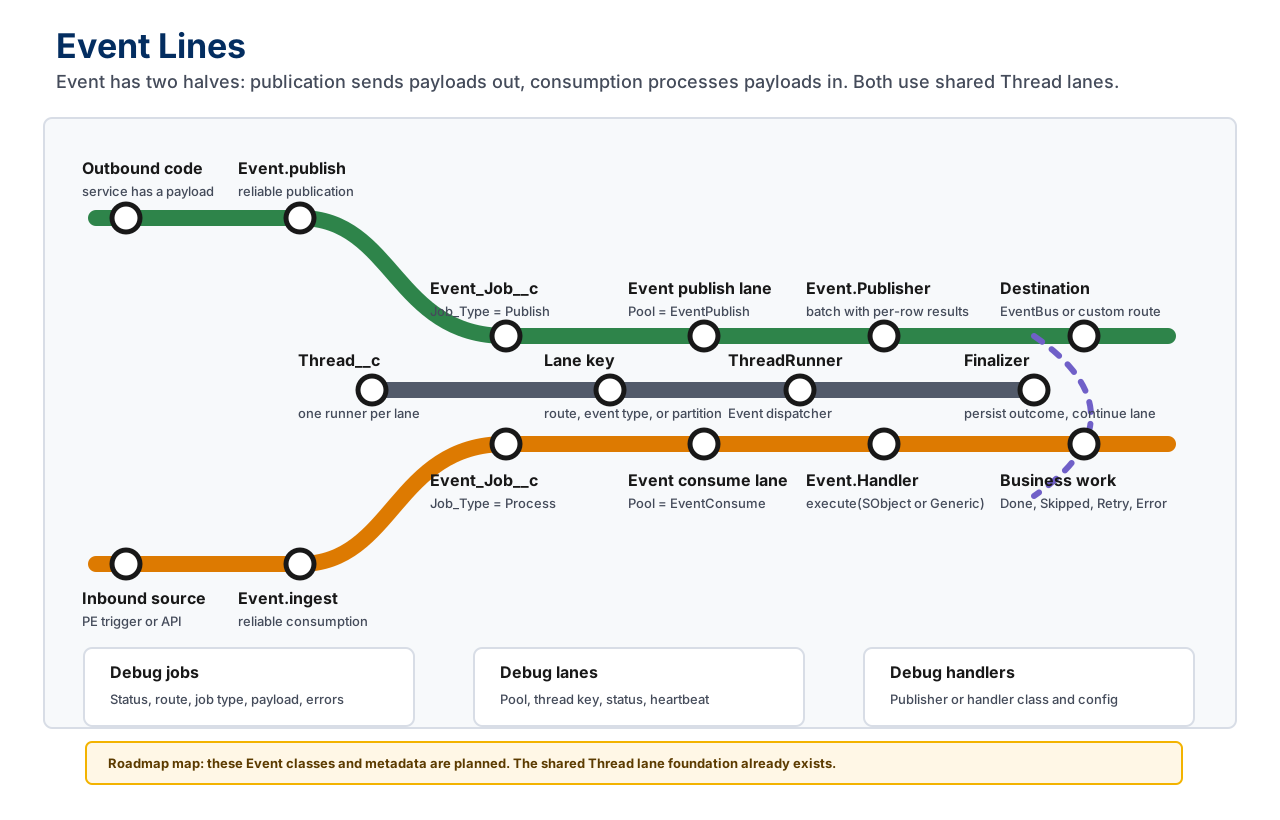
Thread keys are the ordering boundary. Work in one lane drains in FIFO order by
CreatedDate, Order__c, and Name. Separate lanes can move independently
when Thread has capacity.
Strict contiguous batches
EventRelay only drains a contiguous batch that shares the same Apex class, route, and payload type. If the next pending work item in a lane belongs to a different publisher, handler, or route, the current batch stops before it.
That rule keeps one publisher or handler call focused on one coherent payload shape while preserving the lane’s order.
Custom Handlers
Custom handlers extend EventRelay.Handler. Override the execute overload
that matches your payload shape.
public with sharing class ContactChangedHandler extends EventRelay.Handler {
    public override void execute(List<SObject> records) {
        Set<Id> contactIds = new Set<Id>();
        for (SObject record : records) {
            contactIds.add((Id) record.get('Contact_Id__c'));
        }

        processContacts(contactIds);
    }

    void processContacts(Set<Id> contactIds) {
        // Query once, then do bulk-safe work.
    }
}
public with sharing class OrderWebhookHandler extends EventRelay.Handler {
public override void execute(List<Generic> records) {
for (Generic record : records) {
String orderNumber = (String) record.get(
'orderNumber',
String.class
);
if (String.isBlank(orderNumber)) {
fail(record, 'Order number is required.');
}
}
}
}If execute completes, EventRelay marks selected process work items Done by
default. A handler may call complete(record) or fail(record, message) for
individual records when it wants item-level results. Failed items follow the
route’s Max_Retries__c cap: under the cap they return to Pending with
Retry_Count__c incremented; at the cap they become Error.
Platform Event handlers that already override execute(List<Generic>) continue
to work because the base SObject handler path can convert Platform Event records
to Generic. New handlers should prefer execute(List<SObject>) when they want
the Platform Event shape.
Custom Publishers
Custom publishers extend EventRelay.Publisher. Override the execute overload
that matches your payload shape.
public with sharing class ContactWebhookPublisher extends EventRelay.Publisher {
    public override void execute(List<Generic> records) {
        for (Generic record : records) {
            if (String.isBlank((String) record.get('email', String.class))) {
                fail(record, 'Email is required.');
            }
        }
    }
}
Publisher results are item-level. If execute completes and no item is failed,
EventRelay marks every selected payload Done. Call fail(record, message) for
payloads that should end in Error or follow the route’s retry cap. Use
complete(record) or succeed(record) only when a publisher first marked a
record failed and later needs to mark it successful again inside the same batch.
Testing
Test subscriber logic directly. For handlers, construct the handler and call
the execute overload it owns with representative payloads. Mock the
collaborators your handler uses, then assert the business behavior it owns.
@istest
class OrderSubmittedHandlerTest {
    @istest
    static void execute_updatesSubmittedOrders() {
        OrderSubmittedHandler handler = new OrderSubmittedHandler();

        handler.execute(
            new List<SObject>{
                new Order_Submitted__e(Order_Id__c = 'a00000000000001AAA')
            }
        );

        // Assert the DML or service behavior the handler owns.
    }
}
For custom publishers, keep transformation, validation, and delivery code in small methods or collaborators that can be tested directly. In subscriber tests, do not depend on EventRelay’s internal payload/result classes. Bedrock’s own tests cover durable work creation, queue orchestration, item-level result mapping, and background start behavior.
How It Works
Three ideas explain the parts you need as a user.
One: payloads become tracked work. publish and ingest serialize each
payload into Payload1__c through Payload4__c, create one Event__c row per
resolved route, and store the Apex class, route, payload type, lane key, retry
count, and status.
Two: lanes preserve order. Creating work assigns each item to a lane. Work in the same lane drains in order; separate lanes can drain independently when capacity is available.
Three: handlers and publishers write outcomes. Publish work calls the
selected publisher. Ingest work calls the selected handler. Successful items
become Done; failed items become Error or return to Pending when
Max_Retries__c allows another attempt.
Public API
A note on access modifiers. In Apex, an omitted modifier means
private. Members listed here are the intended app-facing surface. Treat other visible framework services and helpers as internal unless this page documents them.
Static entry points
| Member | Signature | Description |
|---|---|---|
publish | public static List<Id> publish(List<SObject> events) | Creates durable publish work for Platform Event SObjects. Uses active Event_Config__mdt publish routes when they match; otherwise uses the built-in Platform Event publisher route. |
publish | public static List<Id> publish(List<SObject> events, Type publisherType) | Creates durable publish work for Platform Event SObjects and routes it to the explicit publisher class. |
publish | public static List<Id> publish(List<Generic> payloads) | Creates durable publish work for generic payloads. Requires an active matching Event_Config__mdt publish route. |
ingest | public static List<Id> ingest(List<SObject> events) | Creates durable process work for Platform Event SObjects. Requires an active matching Event_Config__mdt ingest route. |
ingest | public static List<Id> ingest(List<SObject> events, Type handlerType) | Creates durable process work for Platform Event SObjects and routes it to the explicit handler class. |
ingest | public static List<Id> ingest(List<Generic> payloads) | Creates durable process work for generic payloads. Requires an active matching Event_Config__mdt ingest route. |
ingest | public static List<Id> ingest(List<Generic> payloads, Type handlerType) | Creates durable process work for generic payloads and routes it to the explicit handler class. |
stage | public static void stage(List<SObject> events) | Adds Platform Event SObjects to the current transaction buffer. |
flush | public static List<Id> flush() | Persists buffered Platform Events and returns the new Event__c Ids. Returns an empty list when the buffer is empty. |
Handler contract
| Member | Signature | Description |
|---|---|---|
execute | public virtual void execute(List<SObject> records) | Override this for Platform Event-shaped payloads. The base implementation converts records to Generic and calls execute(List<Generic>), preserving existing Generic handlers. |
execute | public virtual void execute(List<Generic> records) | Override this for generic payloads. The base implementation throws. |
complete | public void complete(SObject record) | Marks one SObject payload successful in the current handler batch. Items are successful by default, so this is only needed after an earlier fail. |
complete | public void complete(Generic record) | Marks one generic payload successful in the current handler batch. Items are successful by default, so this is only needed after an earlier fail. |
fail | public void fail(SObject record, String message) | Marks one SObject payload failed in the current handler batch with a message. |
fail | public void fail(Generic record, String message) | Marks one generic payload failed in the current handler batch with a message. |
Publisher contract
| Member | Signature | Description |
|---|---|---|
execute | public virtual void execute(List<SObject> records) | Override this for Platform Event-shaped payloads. The base implementation throws. |
execute | public virtual void execute(List<Generic> records) | Override this for generic payloads. The base implementation throws. |
complete | public void complete(SObject record) | Marks one SObject payload successful in the current batch. |
complete | public void complete(Generic record) | Marks one generic payload successful in the current batch. |
succeed | public void succeed(SObject record) | Marks one SObject payload successful in the current batch. |
succeed | public void succeed(Generic record) | Marks one generic payload successful in the current batch. |
fail | public void fail(SObject record, String message) | Marks one SObject payload failed in the current batch with a message. |
fail | public void fail(Generic record, String message) | Marks one generic payload failed in the current batch with a message. |
Work metadata
| Artifact | Field | Purpose |
|---|---|---|
Event__c | Apex__c | Publisher or handler class name. Blank publish values use the built-in Platform Event publisher. |
Event__c | Job_Type__c | Publish for outbound publication work or Process for inbound handler work. |
Event__c | Status__c | Work state. Implemented statuses include Pending, Running, Done, Stale, and Error. |
Event__c | Route__c | Route or destination key selected for the payload. |
Event__c | Payload_Type__c | Platform Event API name or Generic. |
Event__c | Thread__c | Lookup to the Thread__c lane that owns the work. |
Event__c | Thread_Key__c | FIFO lane key. |
Event__c | Order__c | Per-create-call ordering value used after CreatedDate. |
Event__c | Retry_Count__c | Stored retry count. Automatic retry increments this value when a failed item is requeued below its configured cap. |
Event__c | Idempotency_Key__c | Optional framework-derived logical work key. Duplicate accepted work for the same job type and route is inserted as Stale. |
Event__c | Payload1__c - Payload4__c | Serialized payload chunks. Each chunk stores up to 32,768 characters. |
Event__c | Error_Message__c | Publisher or handler error, stale duplicate reason, or runtime failure message. |
Event__c | Error_Stack_Trace__c | Runtime failure stack trace when available. |
Route metadata
| Artifact | Field | Purpose |
|---|---|---|
Event_Config__mdt | DeveloperName | Stable route name. Metadata-backed work stores this value in Event__c.Route__c and Event__c.Thread_Key__c. |
Event_Config__mdt | Active__c | Enables the route when true. Inactive routes are ignored. |
Event_Config__mdt | Direction__c | Publish, Ingest, or Both. |
Event_Config__mdt | Source_Type__c | PlatformEvent or Generic. |
Event_Config__mdt | Routing_Key__c | SObjectType for Platform Event routes; a payload key such as EventType for generic routes. |
Event_Config__mdt | Routing_Value__c | Platform Event API name or generic payload value that selects the route. |
Event_Config__mdt | Apex__c | Publisher class for publish routes or handler class for ingest routes. Platform Event publish routes may leave this blank to use the built-in publisher. |
Event_Config__mdt | Batch_Size__c | Optional batch size override for this route. |
Event_Config__mdt | Max_Retries__c | Optional automatic retry cap for failed publish and process work on this route. Blank or zero disables automatic retry. |
Event_Config__mdt | Idempotency_Key_Path__c | Optional Platform Event field API name or Generic path used to derive Event__c.Idempotency_Key__c during intake. |
Runtime defaults
| Setting | Value | Description |
|---|---|---|
| Publish pool | EventRelayPublish | Thread pool used by EventRelay publication lanes. |
| Process pool | EventRelayProcess | Thread pool used by EventRelay process lanes. |
| Batch size | 50 | Default number of work items selected for one publish or process job when the route has no Batch_Size__c. |
| Limit threshold | 90 | Platform Event publish limit safety threshold used with Limiter for the built-in publisher. |
Notes & Edge Cases
publishdoes not publish inline. It records work. Publication runs later in a background transaction.ingestdoes not process inline. It records process work. Handler execution runs later in a background transaction.- Only Platform Event SObjects are accepted by the SObject overloads. The
API name must end in
__e. - No-handler ingest requires config. The no-handler
ingestoverloads throw when no activeEvent_Config__mdtrecord matches the payload. - Generic publishing needs config. Generic payloads throw when no active
Event_Config__mdtpublish route matches the configured routing key/value. - Platform Event publication has a default route. If no SObject routes are resolved, EventRelay uses the built-in Platform Event publisher route.
- Payload storage is finite. Serialized payloads are stored in four long text chunks. Payloads larger than that capacity throw an error.
- Custom publishers are item-level. If
executecompletes and no item is failed, every item is marked successful. - Custom handlers can be item-level. If
executecompletes and no item is failed, every item is marked successful. Usefail(record, message)for the SObject or Generic records that should retry or become terminal errors. - Publisher result records must come from the current batch. Calling
complete(...),fail(...), orsucceed(...)with another object instance throws. - Built-in Platform Event publishing checks limits. When the Platform Event
limit is not safe at the configured threshold, the owning
Thread__cis markedPausedand the publish work remainsPending. - Idempotency is intake-only. Duplicate idempotency keys create terminal
Stalerows for audit. Stale rows do not run. - Strict contiguous batching can make smaller batches. A lane may select fewer than the configured batch size when the next pending work item has a different publisher, handler, route, or payload type.
- Automatic retry is route-configured.
Max_Retries__cgreater than zero requeues failed work until the storedRetry_Count__creaches the cap. Blank or zero leaves failures terminal.